Keynes’s Clearing Union proposal, August 1942 (FRUS 1942, vol. I)
Text of the proposal.
Open the sourceKeynes, White and the City of London, 1944–47
Britain’s financial establishment helped design the postwar monetary order and then found it ran on American terms. This site argues that the City lost the argument at Bretton Woods, was squeezed by the 1945 loan and the 1947 convertibility crisis, and then rebuilt its role through the Eurodollar market.
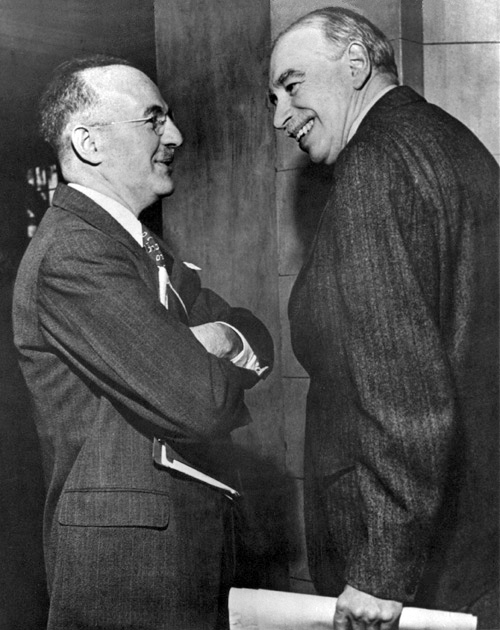
Most of the key meetings happened in Washington or New Hampshire, so the exhibit has to stay with London’s side of the story: the Treasury, the Bank of England, the Cabinet and the banks.
Keynes put his Clearing Union proposal forward in August 1942. The Bretton Woods conference met from 1 to 22 July 1944 and adopted a dollar-based system closer to the American approach. The printed proceedings are online in full.
Text of the proposal.
Open the sourceFull text of the conference record.
Open the sourceThe Anglo-American Financial Agreement was signed on 6 December 1945. It gave Britain a loan of $3.75 billion and a further $650 million to settle lend-lease. Keynes defended it in the House of Lords on 18 December 1945, in a debate we can read in Hansard.
Debate including Keynes’s speech.
Open the sourceShort government history account.
Open the sourceCabinet conclusions of 1 August 1947 (CAB 128/10 at The National Archives) discuss the convertibility of sterling and the dollar drain. The decision to suspend convertibility was taken on 17 August and took effect on 20 and 21 August. Marshall had already made his Harvard speech on 5 June, and Ernest Bevin, hearing it on the BBC, contacted the French foreign minister to arrange the Paris conference.
American diplomatic view of the British crisis.
Open the sourceText of the Harvard speech and the British response.
Open the sourceCatherine Schenk argues that London’s Eurodollar market began in 1955, when Midland Bank started attracting dollar deposits. That is earlier than the usual story, which points to the sterling controls of 1957. The City, tightly regulated at home and freer abroad, turned the dollar system to its own use.
The key article.
Open the sourceShort explainer.
Open the sourceLondon is still a major offshore centre for dollars, and that position grew out of choices made in these years. Current arguments about the dollar’s dominance and calls for a neutral reserve currency echo Keynes’s proposal, which gives the contemporary section a direct line back to 1942.
WhiteandKeynes.jpg, Wikimedia Commons (https://commons.wikimedia.org/wiki/File:WhiteandKeynes.jpg). Source given on the Commons page: International Monetary Fund. Licence on the Commons page: public domain.
